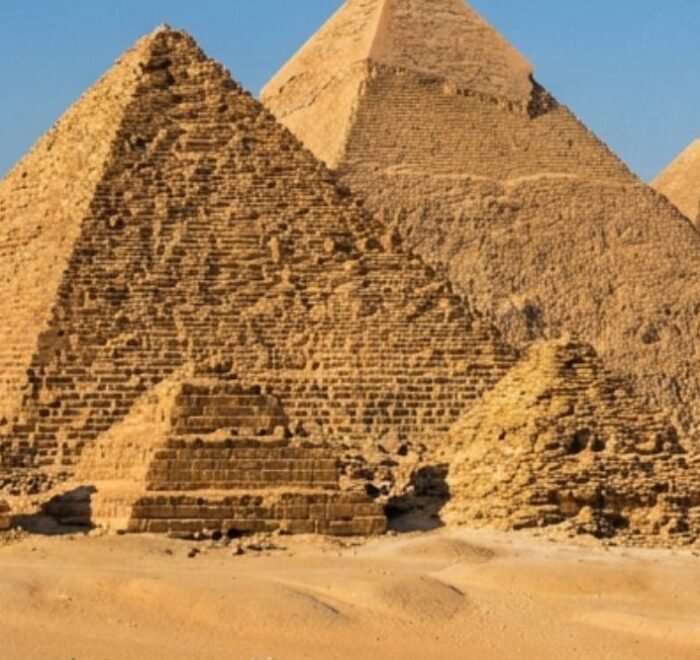
The Giza pyramids are open every day from early morning to late afternoon, about 45–75 minutes from Downtown Cairo. Plan three to four hours for the three pyramids, the Panorama point and the Sphinx, arrive at opening time to beat the heat and crowds, and buy separate tickets if you want to go inside a pyramid. Pair it with the Grand Egyptian Museum next door.
Last updated on October 31st, 2026 at 08:21 pm

The pyramids were royal tombs. Each was the centre of a complex with a mortuary temple, a causeway and a valley temple near the Nile floodplain, designed to protect the king’s body and support his journey into the afterlife. The workers who built them were paid labourers, not slaves – their village and cemeteries have been excavated just south of the Sphinx.

Start at the Great Pyramid of Khufu, the largest, then walk to Khafre’s pyramid and further south-west to Menkaure’s, the smallest of the three. Around them lie fields of mastaba tombs built for officials and members of the royal family. Distances are bigger than they look – allow time and water.
A separate ticket lets you climb the narrow ascending passage and the tall Grand Gallery to the King’s Chamber, which contains an empty granite sarcophagus. It’s an extraordinary space, but the passages are steep, hot and cramped.

The Sphinx – a lion with a king’s head, usually identified as Khafre – is carved from the bedrock of the plateau. The best views are from the viewing terrace beside the Valley Temple, where you can line up the Sphinx with a pyramid behind it.

Camel and horse rides start near the pyramids and the Panorama point. Agree the price, the duration and the route clearly before you get on, and pay at the end. Choose animals that look healthy and well cared for; a guide or tour can arrange a ride with a trusted handler.
Next to the Sphinx, the Valley Temple was where the king’s funeral procession began. Its huge, polished granite blocks and plain pillared hall are some of the finest Old Kingdom building work you’ll see anywhere.

In the evening, the pyramids and Sphinx are lit up for a narrated show that tells their story. It runs in several languages on different nights – check the schedule for your date. Bring a jacket in winter; evenings in the desert are cool.
Interior tickets are sold at the plateau’s ticket office alongside the general entry ticket. The Great Pyramid has its own, more expensive ticket; the pyramids of Khafre and Menkaure and some tombs have cheaper tickets and are sometimes opened in rotation.
Expect a long, low passage where you bend almost double, then the high Grand Gallery and finally the plain granite King’s Chamber. There are no paintings or inscriptions inside. It’s warm and humid, and not suitable for people with claustrophobia, heart problems or limited mobility.

If the Great Pyramid’s ticket feels too expensive, the passages inside Khafre’s or Menkaure’s pyramid give a similar experience for much less, with fewer people.
Expect a long, low passage where you bend almost double, then the high Grand Gallery and finally the plain granite King’s Chamber. There are no paintings or inscriptions inside. It’s warm and humid, and not suitable for people with claustrophobia, heart problems or limited mobility.
No. Climbing the pyramids is forbidden for safety and to protect the monuments, and the police enforce it.

Three to four hours covers the three pyramids, the Panorama point, the Sphinx and the Valley Temple. Add an hour if you go inside a pyramid, and a separate half-day for the Grand Egyptian Museum nearby.
Arrive at opening time in the morning: it’s cooler, the light is better and the tour buses haven’t arrived yet. Avoid midday in summer, when there’s almost no shade on the plateau.

Not from inside the site, which opens after sunrise and closes in the late afternoon. For sunset, watch from a rooftop café or hotel facing the plateau; for sunrise, some hotels in the pyramids area have views from their rooms or terraces.
Light, breathable clothes, a sun hat, sunglasses and sunscreen, and comfortable closed shoes for the sand and uneven ground. In winter, bring a warm layer for the morning and evening.
Uber or a taxi is the easiest way – about 45–75 minutes from Downtown Cairo depending on traffic. Visitors now enter through the visitor centre on the Fayoum road side of the plateau, though some drivers still drop people at the Sphinx entrance. A private transfer or tour with hotel pickup is the simplest option.
The site is large. Electric buses run between the visitor centre and the main stops; you can also walk, or use a car on a guided tour. Walking from the Great Pyramid to the Panorama point takes around 20–30 minutes in the sun.
With a licensed Egyptologist guide and transport, so you understand what you’re looking at and avoid the touts. Our Giza Pyramids and Egyptian Museum day tour includes hotel pickup and a guide, from $30.
Foreign adults paid EGP 700 for general entry to the Giza plateau in 2025, with half price for students. The interior of the Great Pyramid, the smaller pyramids and some tombs need extra tickets. Prices rise regularly, so check the official site egymonuments.gov.eg before you go.
Combine the pyramids with the Grand Egyptian Museum on the same day, or with Saqqara and Memphis further south. If you’d like to wake up with a pyramid view, stay in the pyramids area – see our guide to where to stay in Cairo.
CAIRO: Read our article Top 10 Best Things to Do in Cairo We also have a 3 day Cairo Itinerary and how to take a day trip Saqqara.
LUXOR: Get on overview on what to do in our article Top 10 Things to do in Luxor , Why you should visit Luxor and We also have detailed guides to take A Day Trip to Luxor from Cairo
ASWAN: Read our articles about the top attractions in Aswan and When to visit Aswan and we also have detailed A Comprehensive Travel Guide to Aswan
ALEXANDRIA: Read our article about The top attractions in Alexandria and when you should visit Alexandria and we also have a detailed guide to Alexandria and how to take a day trip from Cairo to Alexandria
Dahab: Read our article about the best things to do in Dahab and when you should visit Dahab and we also have an article about the top attractions in Dahab and how to spend a day in Dahab.
Bahariya Oasis: Read our article about The Best Things to Do in Bahariya Oasis and when you should visit Bahariya Oasis and we also have a detailed guide about how to take 2 Days Trip to Bahariya Oasis from Cairo:
EGYPT ITINERARY: With 8 days in Egypt, visit Cairo, Luxor, Aswan and Abu Simbel.
TRAVEL ADVICE: Here is list of important things to know before visit Egypt. the best time to visit Egypt, Advice for first-time travelers in Egypt, and Top 5 Safety Tips for Traveling to Egypt in 2024 – 2025
The Giza pyramids live up to the hype. Come early, walk to the Panorama point for the classic view, see the Sphinx up close, and decide on the spot whether the passages inside are for you. Then spend the afternoon with Tutankhamun at the Grand Egyptian Museum.
Book this experience: Giza Pyramids and Egyptian Museum day tour – hotel pickup, an Egyptologist guide and the Sphinx, from $30.
–Reasons why you should visit Cairo
–Discover Cairo’s Top Attractions: A Comprehensive Guide to Cairo
–Cairo and Beyond: Exploring the Highlights of Egypt on a Guided Tour
–Cairo’s Culinary Delights: A 3-Day Food Tour
–Discovering Saqqara on a Day Trip from Cairo
–Top 10 Places to Visit in Cairo in 3 Days
–Exploring Cairo in 3 Days
–Where to eat in Cairo?
Pyramids of Giza | Ibn Tulun Mosque | Mosque Madrassa of Sultan Hassan | Prince Mohamed Ali Palace (Al Manial Palace) | The National Museum of Egyptian Civilization | Mosque of Mohamed Ali | Nile River in Egypt | Sharia Al Muizz Li Din Allah | Museum of Islamic Art in Cairo | The Egyptian Museum in Cairo | Khan Al Khalili | Al Azhar Mosque | Grand Egyptian Museum | Cairo Tower | Al azhar park | Downtown | Zamalek Island
All rights reserved © Egypttoursinfo.com Republishing this article and/or any of its contents (text, photography, etc.), in whole or in part, is strictly prohibited.
See the pyramids, the Sphinx and Cairo’s great museums with a local Egyptologist on our Cairo tours.