Last updated on November 12th, 2026 at 05:58 pm
If you learn one polite phrase before your trip, make it Law sama7t. In Egypt it means both “please” and “excuse me”, and it opens almost every request – at a café counter, in a taxi, at a museum ticket window: Law sama7t, el 7esab – “the bill, please”.
This lesson takes 11 polite words one at a time – what each means, how to say it, when to use it, the reply you’ll hear back, and how it sounds in a real moment in Egypt. Some, like Teslam eedak (“bless your hands”) after a good meal, will make people smile.
| Say this | Meaning | When to use it |
|---|---|---|
| Shokran | Thank you | Any time someone helps you |
| Afwan | You’re welcome / Excuse me | To answer “thank you”, or to get past someone |
| Law sama7t | Please / Excuse me | Before any request |
| Asef / Asfa | I’m sorry (man / woman) | When you bump into someone |
| Tfaddal | Go ahead / Please sit | When you offer something |
How to read the numbers: In Egyptian Arabic written with Latin letters, 7 is a breathy “h” and 3 is the deep “ain” sound from the throat. So Law sama7t sounds like “law sa-MAHT”.
Listen: how a Cairo local says it
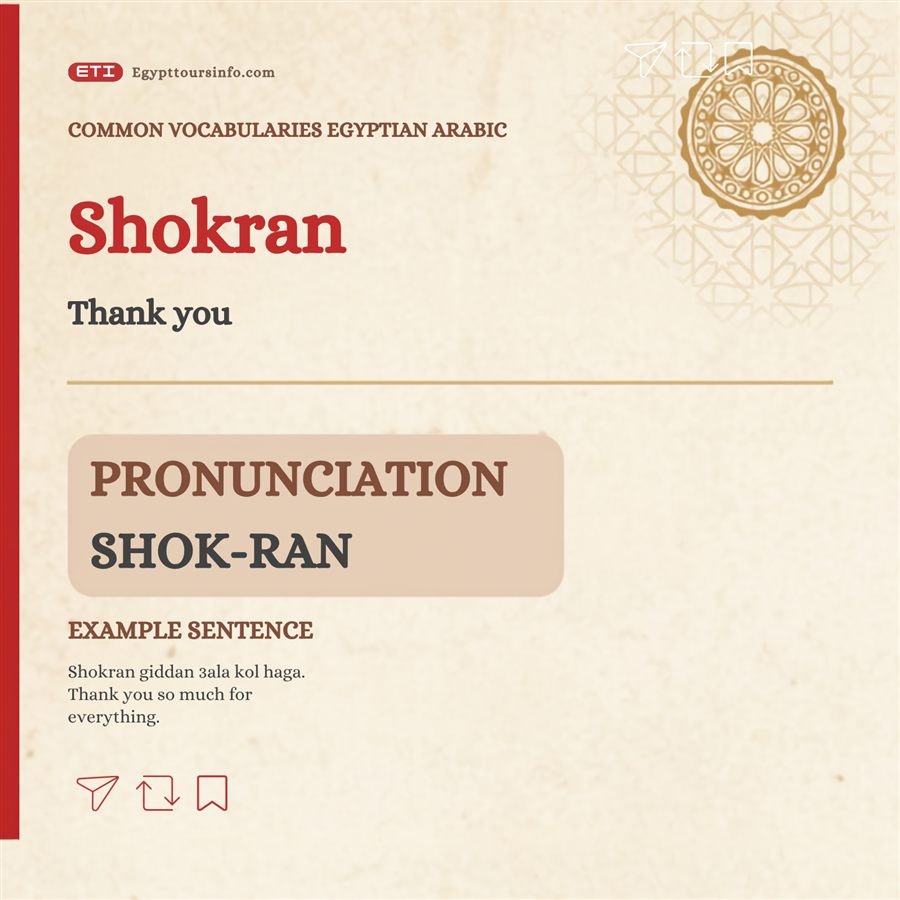
Shokran (SHOK-ran) means “thank you”. For “thank you very much”, add giddan or awi.
How to use it: Use it for every small kindness – a door held, change counted, directions given.
In real life: A stranger shows you the way to the metro: Shokran giddan!
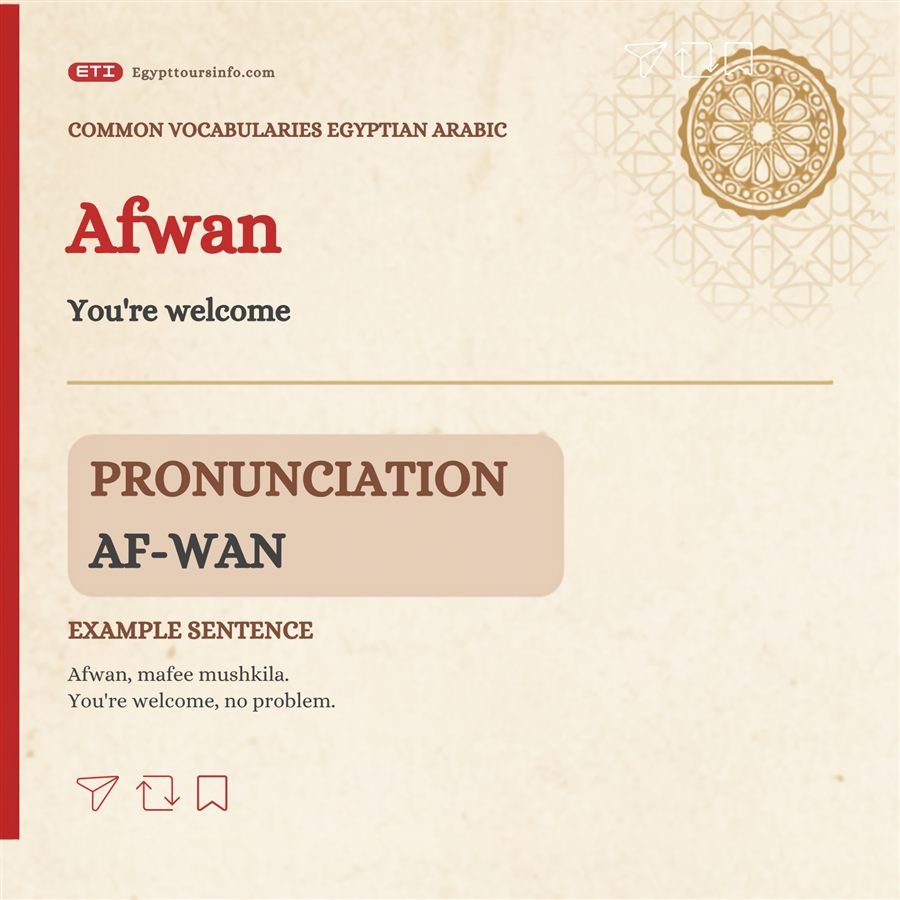
Listen: how a Cairo local says it
Afwan (AF-wan) means “you’re welcome”. You’ll also hear El 3afw (more formal) and Mafeesh mushkila – “no problem”.
How to use it: Use it to answer shokran. It also works as “excuse me” when you need to squeeze past someone in a crowded market.
In real life: In a packed metro carriage: Afwan, afwan – as you make your way to the door.
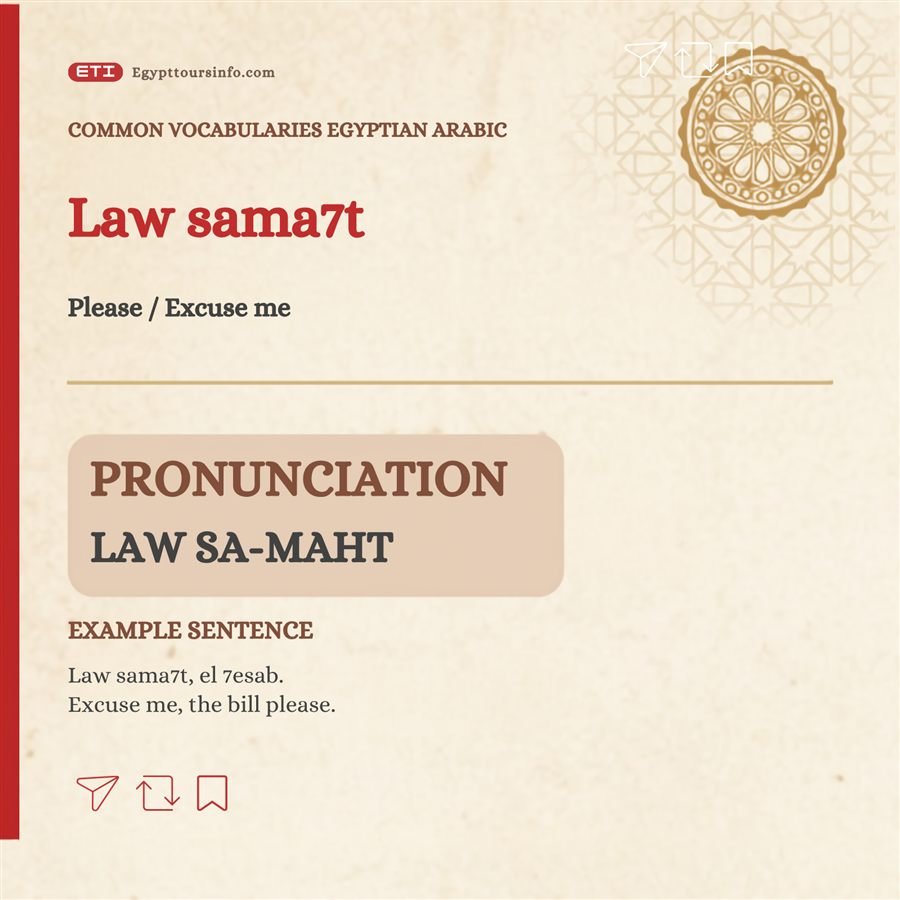
Listen: how a Cairo local says it
Law sama7t (law sa-MAHT) means “please” and “excuse me” at the same time. Say Law sama7ti to a woman.
How to use it: Start almost any request with it – ordering, asking directions, getting someone’s attention.
In real life: At a café: Law sama7t, wa7ed shay – one tea, please. And at the end: Law sama7t, el 7esab – the bill, please.
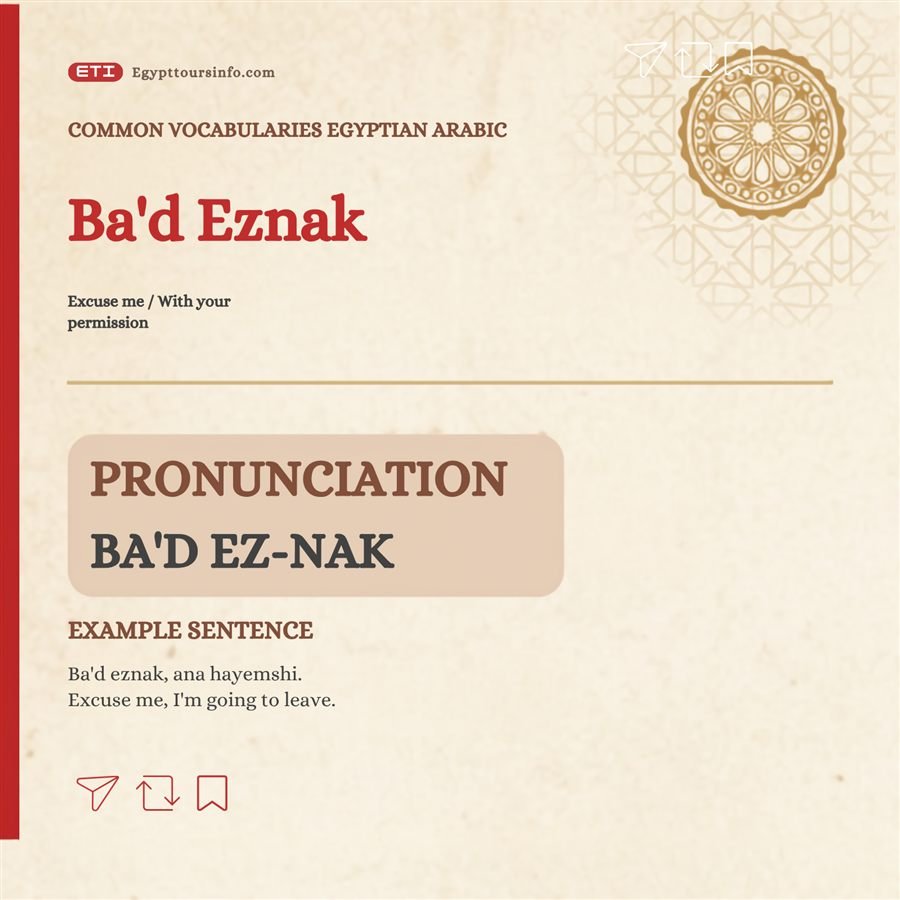
Listen: how a Cairo local says it
Ba’d eznak (BA’D EZ-nak) means “with your permission”. To a woman it’s Ba’d eznek.
How to use it: Use it when you’re about to leave, interrupt, or walk in front of someone.
In real life: Leaving a shop after a long chat: Ba’d eznak, ana hamshi – excuse me, I’m going to head off.
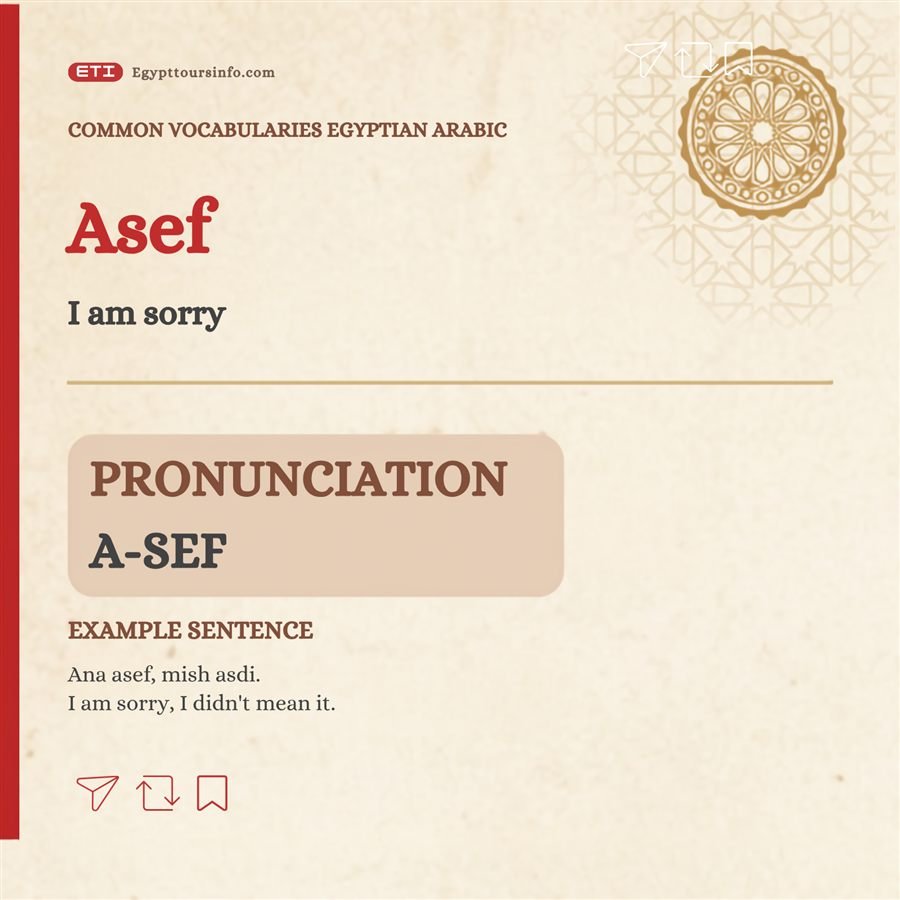
Listen: how a Cairo local says it
Asef (A-sef) means “I’m sorry”. A woman says Asfa.
How to use it: Use it when you bump into someone or make a mistake. The answer you’ll usually hear is Ma’lesh – “never mind, it’s fine” – a word you’ll hear many times a day in Egypt.
In real life: You step on someone’s foot in a queue: Ana asef! – Ma’lesh, ma’lesh.
Listen: how a Cairo local says it
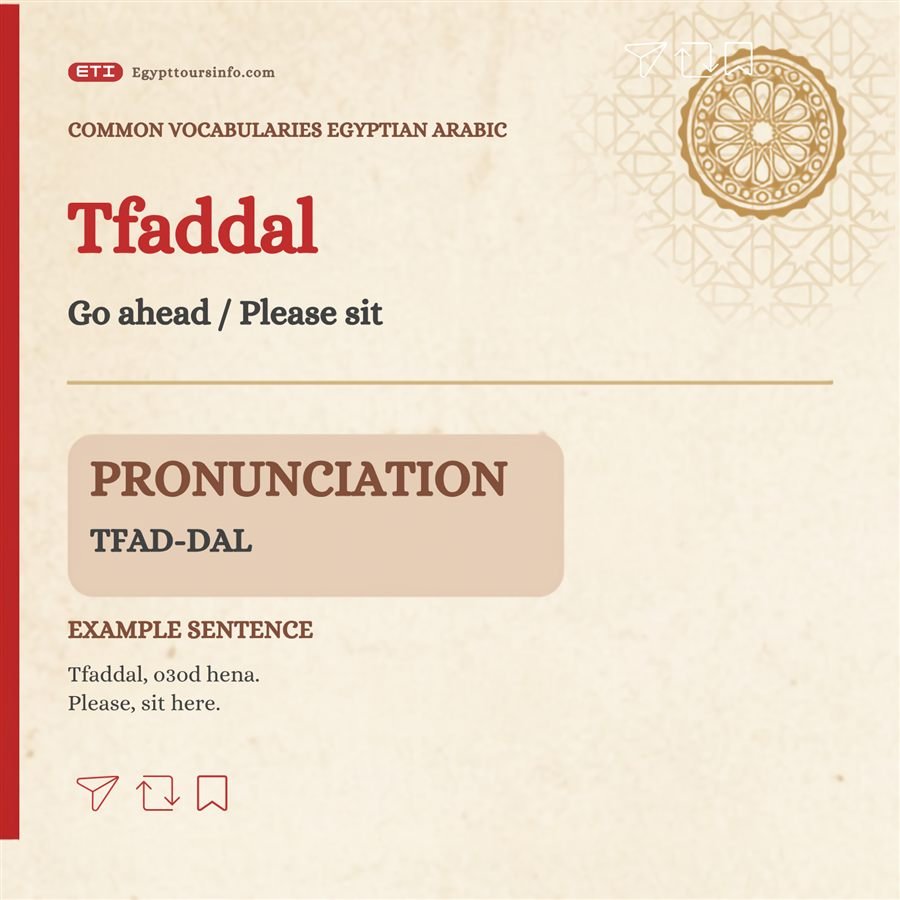
Tfaddal (TFAD-dal) means “please, go ahead / have a seat / help yourself”. To a woman: Tfaddali; to a group: Tfaddalu.
How to use it: You’ll hear it constantly from hosts and shopkeepers. Answer with shokran and accept – sit down, go first or take what’s offered.
In real life: A shopkeeper pulls out a chair: Tfaddal, o3od hena – please, sit here.
Listen: how a Cairo local says it
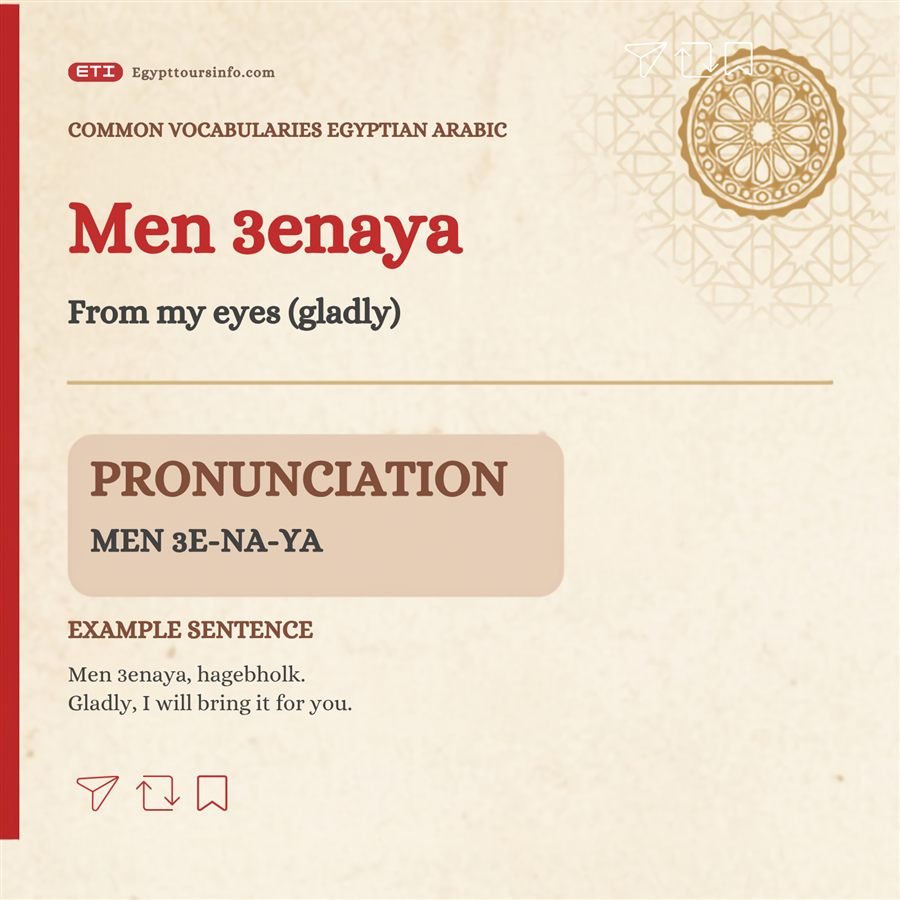
Men 3enaya (men 3e-NA-ya) literally means “from my eyes” – “with pleasure, gladly”.
How to use it: It’s how Egyptians say yes to a favour. Use it yourself when someone asks you for something.
In real life: You ask the receptionist for extra towels: Men 3enaya, hagebholak – gladly, I’ll bring them for you.
Listen: how a Cairo local says it
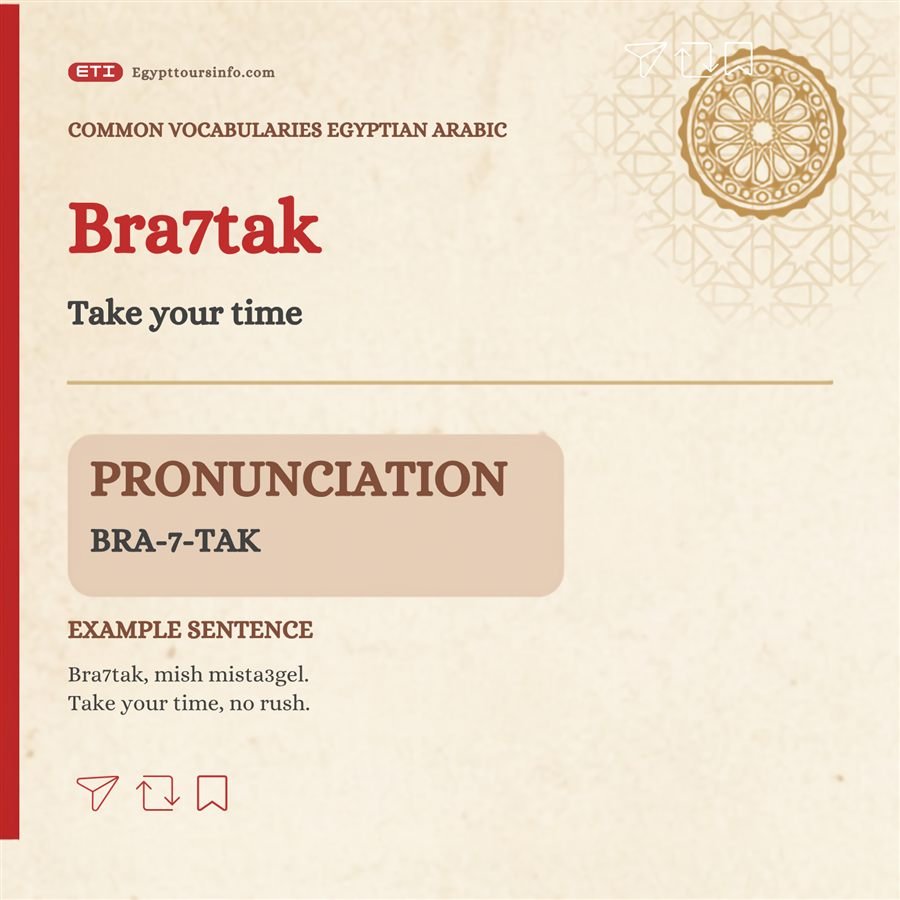
Bra7tak (BRAH-tak) means “take your time”.
How to use it: Use it to tell someone there’s no rush – and expect to hear it when you’re deciding what to buy.
In real life: Choosing between two scarves while the seller waits: he smiles – Bra7tak, mish mista3gel – take your time, I’m in no rush.
Listen: how a Cairo local says it
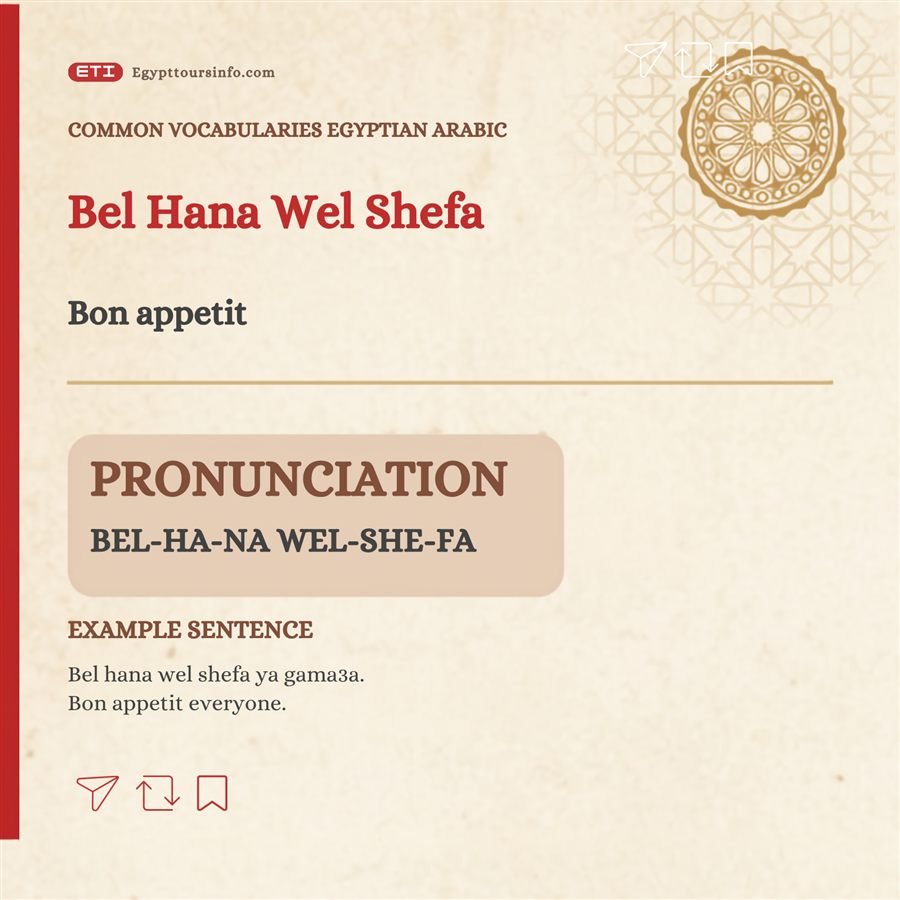
Bel hana wel shefa (bel HA-na wel SHE-fa) means “with happiness and health” – Egypt’s bon appetit.
How to use it: Hosts and waiters say it when food arrives. The reply is Allah yehanneek – “may God make it pleasant for you”.
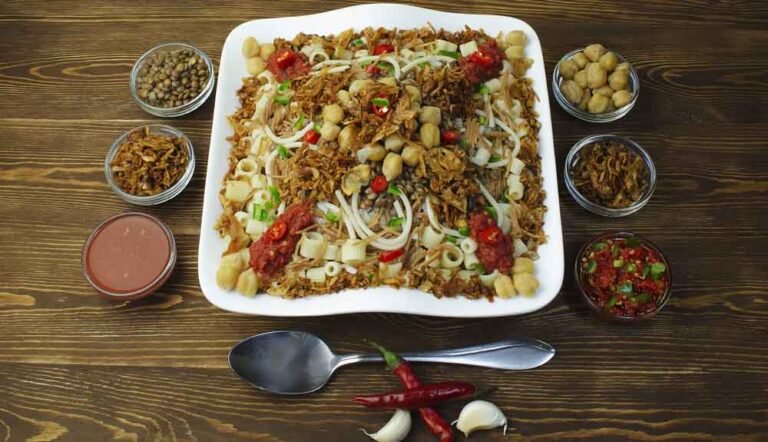
In real life: The koshari arrives at your table: Bel hana wel shefa! – Allah yehanneek.
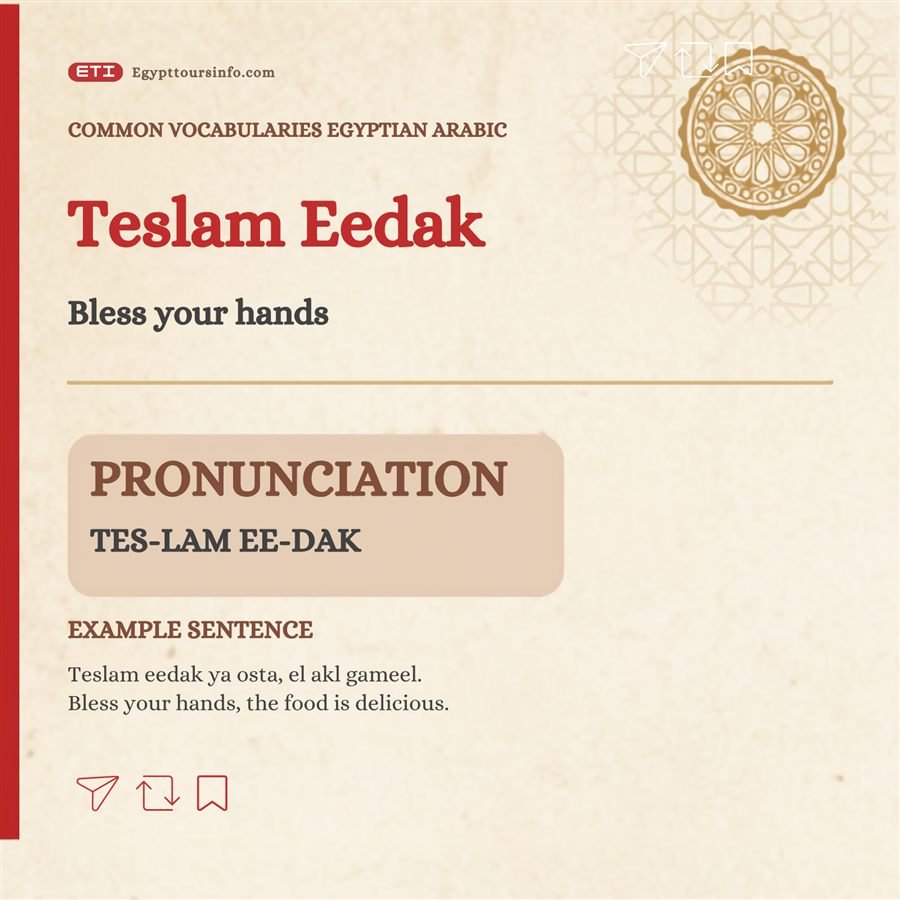
Listen: how a Cairo local says it
Teslam eedak (TES-lam EE-dak) means “bless your hands”. To a woman: Teslam eedek.
How to use it: Say it to anyone who cooked, fixed or made something for you. The reply is W eedak – “and your hands”.
In real life: After a home-cooked lunch: Teslam eedek, el akl gameel awi – bless your hands, the food is delicious.
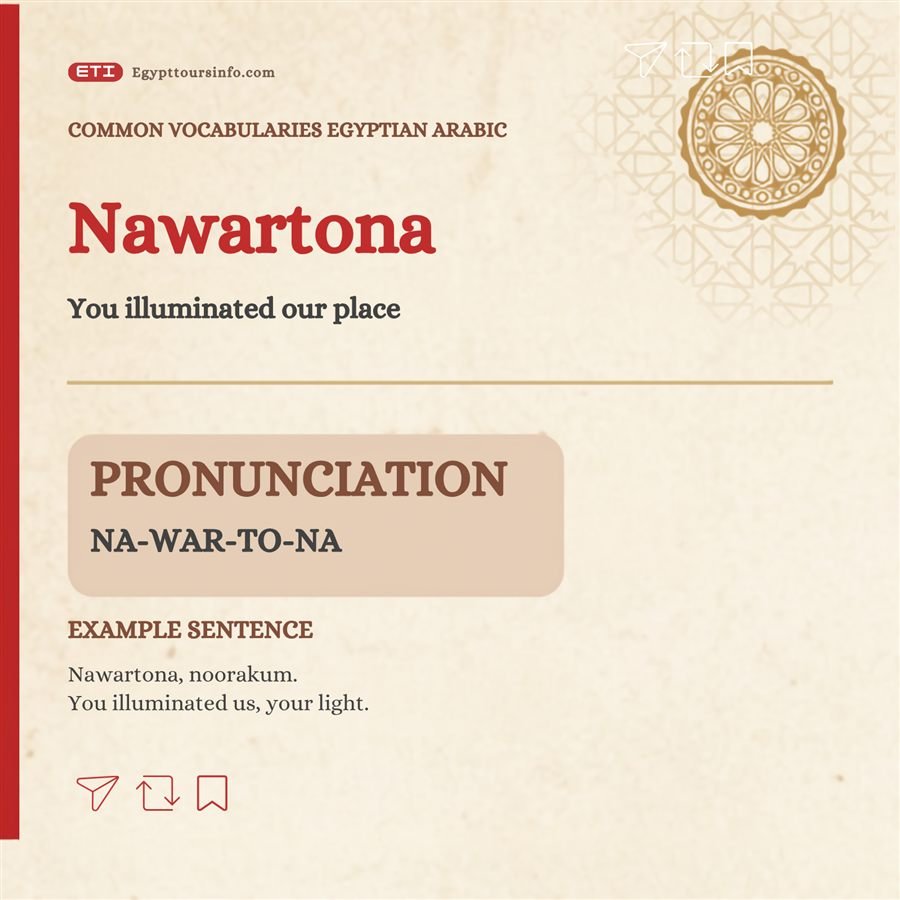
Listen: how a Cairo local says it
Nawartona (na-WAR-to-na) means “you lit up our place” – a warm welcome for guests.
How to use it: You’ll hear it when you arrive somewhere, or when you leave. The reply is Da nourak – “it’s your light”.
In real life: Arriving at a family’s home for dinner: Nawartona! – Da nourak.
More in our guide to Egypt’s culture and customs.
Screenshot this table and keep it on your phone.
| Egyptian Arabic | Pronunciation | Meaning | Reply |
|---|---|---|---|
| Shokran | SHOK-ran | Thank you | Afwan |
| Afwan | AF-wan | You’re welcome | – |
| Law sama7t / sama7ti | law sa-MAHT | Please / Excuse me | Aiwa? (yes?) |
| Ba’d eznak / eznek | BA’D EZ-nak | With your permission | Etfaddal |
| Asef / Asfa | A-sef | I’m sorry | Ma’lesh |
| Tfaddal / Tfaddali | TFAD-dal | Go ahead / Please sit | Shokran |
| Men 3enaya | men 3e-NA-ya | Gladly | – |
| Bra7tak | BRAH-tak | Take your time | Shokran |
| Bel hana wel shefa | bel HA-na wel SHE-fa | Bon appetit | Allah yehanneek |
| Teslam eedak | TES-lam EE-dak | Bless your hands | W eedak |
| Nawartona | na-WAR-to-na | You lit up our place | Da nourak |
How do you say thank you in Egyptian Arabic?
Shokran. For “thank you very much”, Shokran giddan or Shokran awi.
How do you say please in Egyptian Arabic?
Law sama7t to a man or Law sama7ti to a woman. It also means “excuse me”.
What does “teslam eedak” mean?
“Bless your hands”. Egyptians say it to thank someone who cooked, fixed or made something for them.
What do I say if someone says “tfaddal”?
Say Shokran and accept: sit down, go first or take what’s offered.
Do Egyptians expect tourists to speak Arabic?
No – English is widely spoken in tourist areas. But a Shokran or a Teslam eedak is always noticed.
Say Shokran often, start your questions with Law sama7t, and don’t leave a good meal without a Teslam eedak. A dinner out is the easiest place to try all three in one evening.
Previous lesson: Egyptian Arabic greetings – salam, ezayyak and how to answer like a local.
Next lesson in the series: yes, no and everyday reactions – aiwa, la’, mashy and khalas.
Practise over dinner: our Nile dinner cruise in Cairo from $35, with hotel pickup – a good evening to try Bel hana wel shefa (price October 2026).
All rights reserved © Egypttoursinfo.com Republishing this article and/or any of its contents (text, photography, etc.), in whole or in part, is strictly prohibited.
Hand-picked day tours and trips from Cairo, with hotel pickup and friendly local guides.