
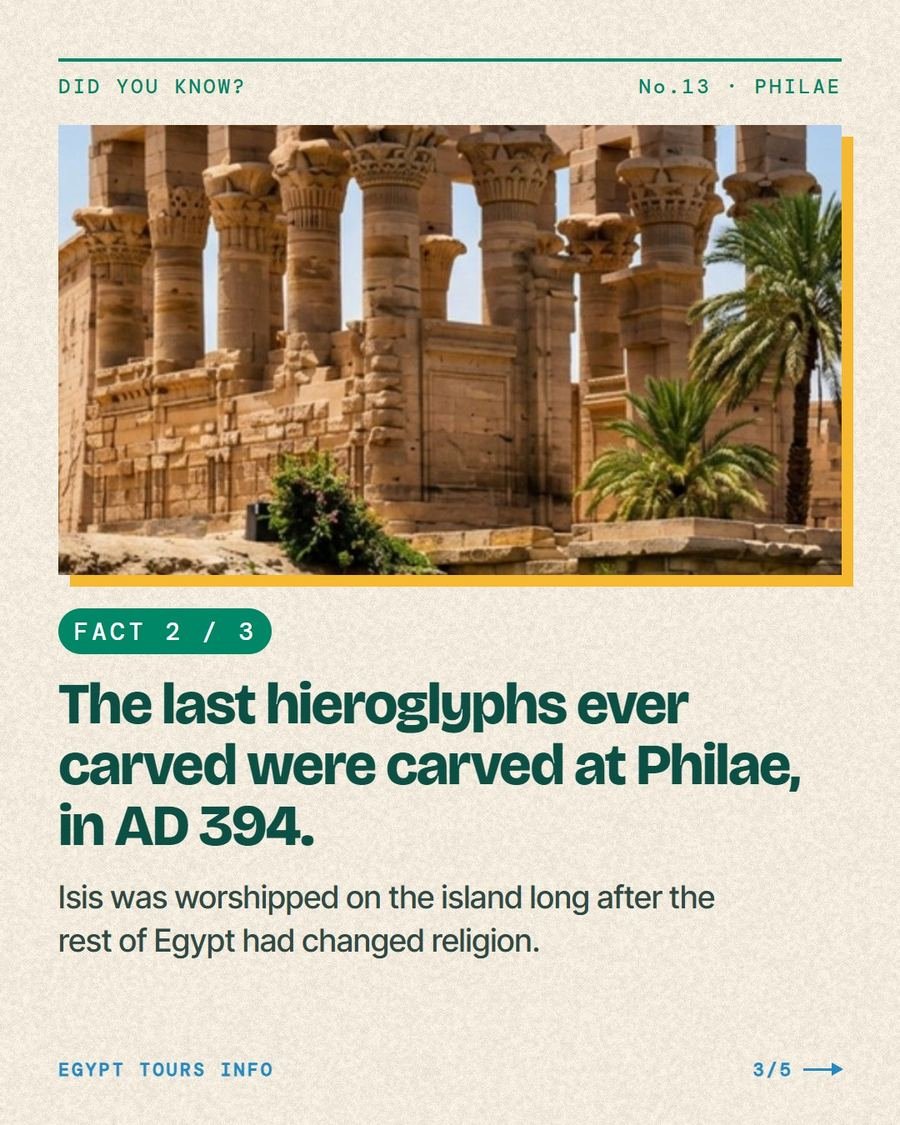
On 24 August AD 394, someone at Philae Temple carved a short prayer in hieroglyphs. It is the last dated inscription we have in the script, and within a few generations nobody alive could read it. For about 1,400 years, the walls of Egypt said nothing to anyone.
Egyptian hieroglyphs are a full writing system of more than 700 signs in regular use, and they stand for sounds as well as ideas. They were used for about 3,500 years. This guide explains how they worked and how they were cracked. It also shows you how to pick out a king’s name on a temple wall with no training at all.
The word comes from Greek and means “sacred carving”. The Egyptians themselves called the script medu netjer, “the words of the gods”, and believed it was a gift from Thoth, the god of writing.
The earliest known Egyptian writing dates to around 3200 BC, close to the first writing in Mesopotamia. Early signs recorded names, goods and royal events on labels and pottery. By the Old Kingdom, the system could carry full sentences. The Pyramid Texts at Saqqara, carved around 2350 BC, are among the oldest religious writings in the world.
Only a small share of people could read, and scribes held a respected job. Hieroglyphs were the formal script, used where words had to last: temple walls, tombs, obelisks and statues. A carved name was thought to keep a person alive after death, which is why some rulers had their rivals’ names chiselled out. You can still see gaps where Hatshepsut’s name was attacked.
Royal names sit inside an oval called a cartouche, a loop of rope meant to protect the name. Texts cover prayers, spells for the afterlife, royal victories and temple rituals. Everyday business like letters and accounts was written in faster scripts on papyrus.
The last priests who knew the script died out after Christianity spread and the temples closed. Later visitors guessed wildly. For centuries, many scholars believed each sign was a mystical symbol rather than part of a language, and that wrong idea held everyone back. The key came from a broken slab in the Delta.
The Rosetta Stone was found in 1799 by French soldiers near the town of Rashid, which Europeans called Rosetta. It carries one decree from 196 BC in three scripts: hieroglyphic, Demotic and Greek. Since scholars could read the Greek, they had a way in.
Thomas Young, an English scholar, worked out that a cartouche spelled the name Ptolemy. Jean-François Champollion then went much further. He compared royal names, including Cleopatra’s on an obelisk from Philae, and used his knowledge of Coptic, the last stage of the Egyptian language. In 1822 he announced that hieroglyphs recorded sounds as well as ideas. The stone is now in the British Museum in London.
Hieroglyphs use three kinds of sign together. Sound signs spell consonants, much like letters. Word signs show a whole word, so a drawing of a house can mean “house”. Silent signs called determinatives come at the end of a word to show its meaning. Vowels were not written, which is why we still argue about how the language sounded.
The script can run left to right, right to left or in columns. Here is the trick: people and animals face the start of the line, so you read toward their faces.
| Script | Used for | Period |
|---|---|---|
| Hieroglyphic | Monuments and sacred texts | About 3200 BC to AD 394 |
| Hieratic | Quick handwriting on papyrus | From about 3000 BC |
| Demotic | Everyday documents | From about 650 BC |
| Coptic | Egyptian in Greek-based letters | From about the 2nd century AD, still used in church services |
There was no true alphabet, but about 24 signs stood for single sounds. Learn a few of these and you will start spotting them everywhere.
| The sign shows | Sound |
|---|---|
| Reed leaf | i or y |
| Foot | b |
| Owl | m |
| Water ripple | n |
| Mouth | r |
| Folded cloth | s |
| Loaf of bread | t |
| Horned viper | f |
Find an oval with a straight line at one end. That is a royal name. Now look for a circle, the sun disk of Ra, because many pharaohs put it in their names. There is a twist: gods’ names were written first out of respect, even when they were spoken later. Tutankhamun’s name starts with the signs for Amun, though the god comes last when you say it.
Ramesses II is the easiest king to practise on, since his cartouches are all over Egypt. Ask your guide to point out one, then hunt for the same shape on the next wall. In Khan el-Khalili you can also have your own name made as a cartouche pendant, but those spell modern names sign by sign, so treat them as a souvenir, not as ancient Egyptian. Our haggling guide helps with the price.
Numbers are one of the easiest things to read on a temple wall, because the system simply repeats signs. Each power of ten has its own sign, and you add them up. Three coils of rope and two strokes, for example, make 302. Look for numbers in lists of offerings, in dates and in records of goods brought back from wars.
| Sign | Value |
|---|---|
| A single stroke | 1 |
| A hobble for cattle, shaped like an upside-down U | 10 |
| A coil of rope | 100 |
| A lotus plant | 1,000 |
| A raised finger | 10,000 |
| A tadpole | 100,000 |
| The god Heh, kneeling with raised arms | 1,000,000 |
Temple walls repeat a small set of signs and phrases, so learning a handful of them goes a long way.
A popular first book is How to Read Egyptian Hieroglyphs by Mark Collier and Bill Manley, which teaches through real inscriptions in the British Museum. Serious students move on to Alan Gardiner’s Egyptian Grammar. Its sign list, which sorts the signs into lettered groups such as A for men and G for birds, is still how Egyptologists refer to them. Learn the single-sound signs first, then practise on cartouches during your trip, and you will be surprised how much you can pick out in a week.
| Place | Why go |
|---|---|
| Karnak | The largest carved walls in the country, with battle scenes and huge columns |
| Edfu | Almost every surface is written on, in very good condition |
| Philae | Home of the last dated inscription |
| Saqqara | The Pyramid Texts in the pyramid of Unas, when it is open |
| Valley of the Kings | Painted texts in full colour |
| Abydos | A list of kings carved in the Temple of Seti I |
| Grand Egyptian Museum | Close-up views of objects with royal names |
More than 700 signs were in regular use for most of Egyptian history. The number grew to several thousand in the late Greek and Roman period.
Yes. Start with the single-sound signs and a few royal names, then move on to a beginner’s grammar. Middle Egyptian is the usual stage to learn first.
Read toward the faces of the people and animals. Lines can run left to right, right to left or top to bottom.
Jean-François Champollion announced the breakthrough in 1822, building on earlier work by Thomas Young and others.
No, it is in the British Museum in London. It was found in Egypt in 1799.
At Karnak, Luxor Temple, Edfu, Kom Ombo, Philae and the royal tombs, and in the museums of Cairo.
You do not have to learn the script to enjoy it. Learn the cartouche trick and the rule about reading toward the faces, then spend a slow hour at Karnak and Edfu. If you like this kind of detail, read 20 facts about Egypt or our guide to Egyptian art next.
Book this experience: Budget Luxor Day Tour to the East Bank from $25.


