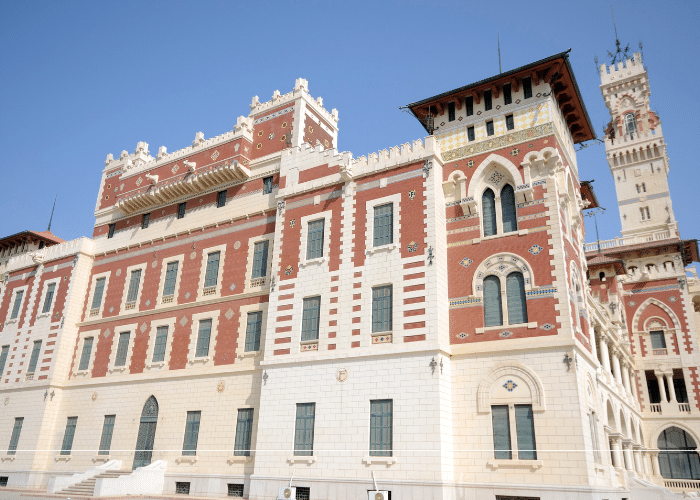
The Mosque of Abu al-Abbas al-Mursi is the most prominent mosque in Alexandria, on the Eastern Harbour in the Anfoushi area, beside the Qaitbay Citadel. It holds the tomb of a 13th-century Sufi saint and is a working place of prayer. Visit outside prayer times, dress modestly and allow 20 to 30 minutes.


The Mosque of Abu al-Abbas al-Mursi is the best-known mosque in Alexandria, on the Eastern Harbour in the Anfoushi district, a short walk from the Qaitbay Citadel. It is built around the tomb of Abu al-Abbas al-Mursi, a Sufi saint from Murcia in Andalusia who settled in Alexandria and died here in 1287. It is a working mosque, and many Egyptians come to pray and to visit the tomb.
| Where | Anfoushi, Eastern Harbour, Alexandria; near Qaitbay Citadel |
| Built | 1929 to 1945, on the site of older shrines |
| Architect | Mario Rossi, an Italian architect who worked for Egypt’s ministry of religious endowments |
| Entry | Usually free; donations welcome |
| Time needed | 20 to 30 minutes |
| Dress | Shoulders and knees covered; women cover their hair; shoes off at the door |
Abu al-Abbas al-Mursi was born in Murcia, in Muslim Spain, in 1219. His family set out on the pilgrimage to Mecca, but their ship was wrecked off North Africa, and he later settled in Alexandria, where he taught for more than 40 years. He died in 1286 and was buried near the harbour. The Mamluk governor of Alexandria rebuilt the shrine in 1477, and it was rebuilt again in the 18th century as the city grew around it.
Two other Sufi figures are buried close by: the poet al-Busiri, author of the famous poem in praise of the Prophet known as the Burda, and Yaqut al-Arshi. Their shrine-mosques stand on the same square, which King Fuad I ordered to be laid out in the 1930s.
Abu al-Abbas al-Mursi was a follower of the Sufi master Abu al-Hasan al-Shadhili and became the leading figure of the Shadhiliyya order in Alexandria. A small shrine was built over his grave, and over the centuries it was rebuilt and enlarged several times.
The mosque you see today was built between 1929 and 1945 to a design by Mario Rossi. He used an octagonal plan with domes and a tall, slender minaret, and filled the interior with arches, carved stone and decorated ceilings in a Mamluk-revival style. The light-coloured stone and the setting on the harbour square make it one of the city’s landmarks.
The moulid (birthday festival) of Abu al-Abbas is one of the biggest in Alexandria, with crowds, Sufi chanting and street stalls; it is a memorable sight, but very busy.
The mosque stands on the Corniche in Anfoushi, at the western end of the Eastern Harbour. From central Alexandria (Raml Station) it is about 10 to 15 minutes by taxi or ride-hailing app, or a pleasant 40-minute walk along the seafront. From the Qaitbay Citadel it is only about 10 minutes on foot. Most Cairo to Alexandria day trips pass it between the citadel and lunch, so ask your guide to stop for 20 minutes.
The best time to visit is mid-morning or late afternoon, between prayers, when the square is calm and the light on the cream stone is soft.
It is in the Anfoushi district, on the Eastern Harbour waterfront near the Qaitbay Citadel.
Visitors are generally welcome outside prayer times if they dress modestly and take off their shoes. Rules can change, so ask at the entrance.
Cover shoulders and knees. Women usually cover their hair with a scarf. Shoes are removed at the door.
Entry is usually free, with donations welcome. Check locally.
The Italian architect Mario Rossi, who designed it in the 1920s; it was finished in 1945.
The Qaitbay Citadel, the Eastern Harbour Corniche and several seafood restaurants are all within walking distance.
Yes, it is a working mosque open daily; visitors should come between prayer times and avoid Friday midday prayers.
Al-Mursi Abu al-Abbas is a short, quiet stop beside the Eastern Harbour. Visit outside prayer times, dress modestly, and pair it with the Qaitbay Citadel and a seafront walk.
Book a nearby tour: Cairo to Alexandria day trip from $60.