
Hatshepsut and Cleopatra are the two best-known women who ruled Egypt. Hatshepsut reigned as pharaoh around 1479 to 1458 BC and built one of the finest temples in Egypt. Cleopatra VII was the last active ruler of ancient Egypt and died in 30 BC. This guide tells their stories and shows where to see their monuments.
Most royal women in Egypt held power as the king’s wife or mother. A queen could act as regent for a young son, run the palace estates and lead religious rites, but the throne itself was meant for a man. Only a handful of women broke that rule and ruled in their own right, and they are spread across 3,000 years of history:
Hatshepsut and Cleopatra lived about 1,400 years apart. Hatshepsut ruled a rich empire at the height of the New Kingdom; Cleopatra fought to keep Egypt independent while Rome swallowed the Mediterranean. See also our guide to women in ancient Egypt.
Hatshepsut was the daughter of Thutmose I and the wife of her half-brother Thutmose II. When he died, the heir was Thutmose III, a small boy born to a minor wife. Hatshepsut ruled for him as regent, and after a few years she was crowned pharaoh herself. She never removed the boy: the two were officially co-rulers, but she held the real power.
To be accepted, she used the language of kingship. Statues and reliefs show her with the false beard, the kilt and the crowns of a king, and texts on her temple say the god Amun was her true father. In some inscriptions she is called “he”, in others “she”.
What she achieved:
About 20 years after her death, in the later reign of Thutmose III, many of her statues were smashed and her name cut out of monuments. Historians now think this was political, to make the line of male kings look unbroken, rather than personal revenge. In 2007 a mummy found in a small tomb in the Valley of the Kings was identified as hers, though some scholars still debate the evidence. Read our Hatshepsut Temple guide.
Cleopatra VII was born in 69 BC into the Ptolemaic dynasty, Macedonian Greeks who had ruled Egypt since the death of Alexander the Great. She was the first of her family known to speak Egyptian, and ancient writers say she spoke many languages and was famous for her wit and education more than her looks.
She came to the throne in 51 BC at about 18, sharing power with her younger brother Ptolemy XIII. They fell out and she was driven from Alexandria. When Julius Caesar arrived in 48 BC she won his support, and after the war that followed, her brother drowned in the Nile and she ruled again, now with Caesar’s backing. She had a son by Caesar, Caesarion.
After Caesar was murdered in 44 BC she allied with Mark Antony, and had three children with him. Their joint forces lost the naval Battle of Actium in 31 BC to Octavian, the future emperor Augustus. As Octavian took Alexandria in 30 BC, Antony killed himself and Cleopatra died soon after. The story of the asp is the best known, but the exact way she died is still debated. Egypt then became a Roman province.
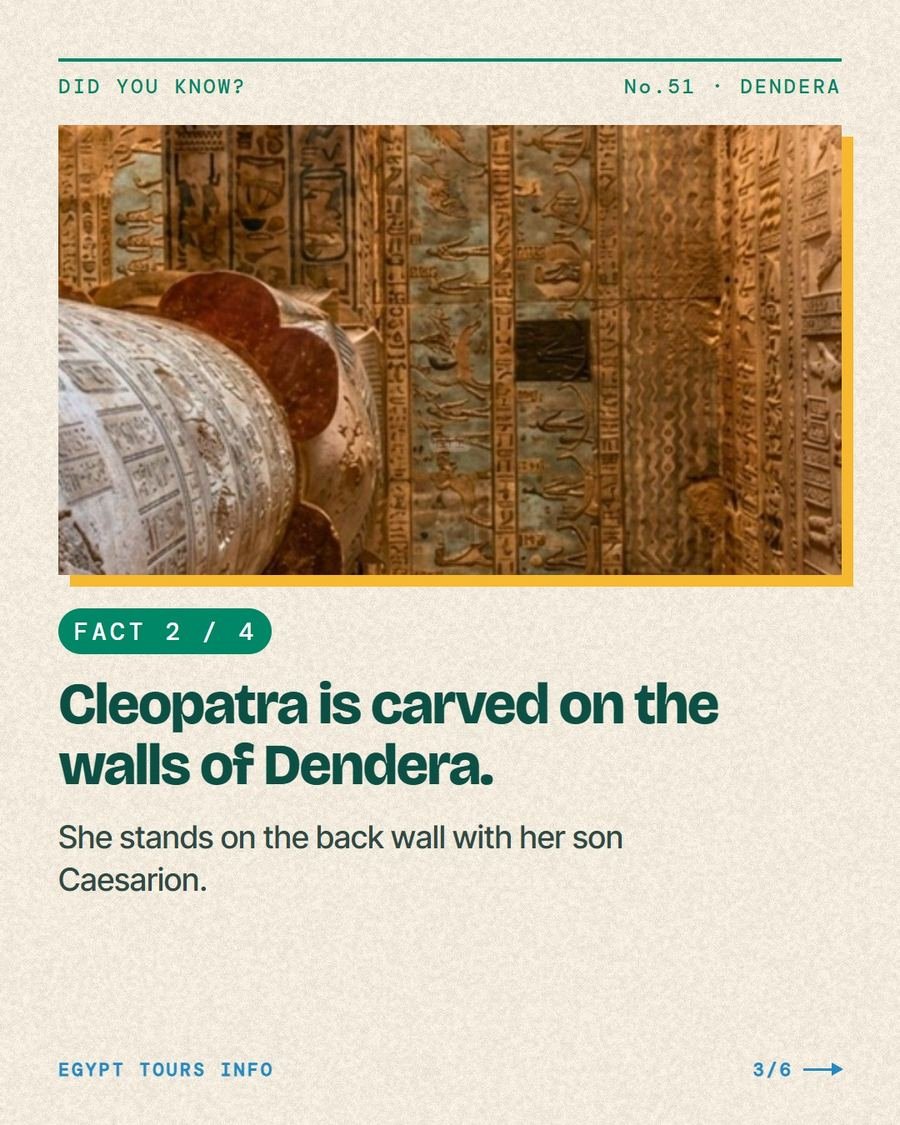
Her tomb has never been found. You can see her portrait in Egyptian style, with Caesarion, on the back wall of the Temple of Hathor at Dendera. Alexandria was her capital; much of her royal quarter now lies under the Eastern Harbour.
| Hatshepsut | Cleopatra VII | |
|---|---|---|
| Lived | About 1507 to 1458 BC | 69 to 30 BC |
| Dynasty | 18th Dynasty, New Kingdom | Ptolemaic (Macedonian Greek) |
| How she ruled | As pharaoh, often shown with the king’s beard | As queen, with co-rulers and Roman allies |
| Known for | Peaceful trade, the expedition to Punt, great building | Politics with Julius Caesar and Mark Antony |
| Where to see her | Temple at Deir el-Bahari, Karnak obelisk | Dendera relief, Alexandria |
| Place | Where | What links it to them |
|---|---|---|
| Hatshepsut’s temple, Deir el-Bahari | Luxor West Bank | Punt expedition reliefs, divine birth scenes, Hathor chapel |
| Karnak Temple | Luxor East Bank | Hatshepsut’s standing obelisk and her Red Chapel, rebuilt in the open-air museum |
| Grand Egyptian Museum and the Egyptian Museum | Giza and Cairo | Statues and objects from Hatshepsut’s reign |
| Dendera Temple | About 1.5 hours north of Luxor | Relief of Cleopatra and Caesarion |
| Alexandria | Mediterranean coast | Her capital; the Eastern Harbour and finds in the city’s museums |
Hatshepsut’s temple and Karnak fit into one day in Luxor, and Dendera is an easy half-day trip from Luxor, so you can follow both women on the same visit.
Hatshepsut and Cleopatra show that women could hold real power in Egypt. See Hatshepsut’s temple and Dendera in one Luxor trip to follow both stories.
Book this experience: Private Full-Day Tour to Explore the West Bank of Luxor from $25.
A powerful ruler of the 18th dynasty who reigned as pharaoh around 1479 to 1458 BC.
She was of Macedonian Greek descent but ruled Egypt and learned the Egyptian language.
At Deir el-Bahari on the West Bank of Luxor.
She died in 30 BC after the defeat by Rome; the details are debated.
About 20 years, from around 1479 to 1458 BC, first as regent and then as pharaoh alongside the young Thutmose III.
No. About 1,400 years separate them: Hatshepsut lived in the 15th century BC and Cleopatra died in 30 BC.
Late in the reign of Thutmose III many of her images were destroyed, probably to make the royal line look like an unbroken line of men.
Get ready for the trip of a lifetime as we bring you the best of Egypt has to offer. Explore the awe-inspiring wonders of the Egyptian ancient civilization, immerse yourself in rich history, and experience the magic of Egypt’s enchanting landscapes.
With our carefully crafted tour packages, you can finally fulfill your lifelong dream of visiting Egypt. From cruising down the majestic Nile River to discovering the magnificent temples of Aswan, every moment will leave you breathless, Don’t miss out on this opportunity! Book your customized Egypt tour package now and embark on an unforgettable journey through time.

Egypt travel blog dedicated to providing the best possible information for traveling to Egypt. Our articles include information on best holiday Destinations in Egypt, Things to do in Egypt, How to get Around in Egypt, and of course planning Your Perfect Itinerary for your holidays in Egypt.


